
Table of Contents
- Why Project Management Methodology Matters
- Agile vs. Waterfall: The Core Divide
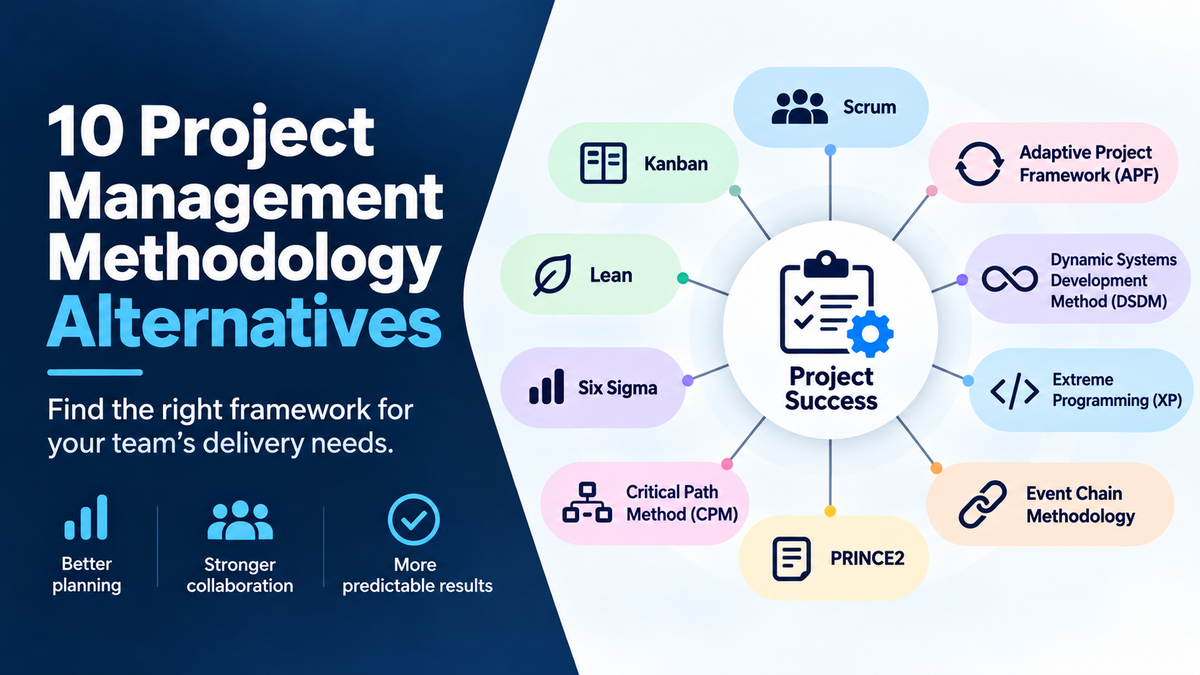
- Project Management Methodology Examples You Can Implement
- Scrum
- Kanban
- Lean
- Six Sigma
- Critical Path Method (CPM)
- PRINCE2
- Event Chain Methodology
- Extreme Programming (XP)
- Dynamic Systems Development Method (DSDM)
- Adaptive Project Framework (APF)
- Hybrid Project Management: Combining Methodologies
- Project Management Frameworks: Choosing the Right One
- How to Select a Methodology for Your Team
- Moving Beyond Methodology: Building Repeatable Systems
- Conclusion
Why Project Management Methodology Matters
Choosing the right project management methodology shapes how your team communicates, decides, handles scope changes, and finishes on time.
No single approach works for every project. A rigid waterfall would paralyze a software team iterating through features, while Agile's daily standups can overwhelm a distributed consulting firm.
The teams that succeed don't force their work into a methodology from a list, they understand the core differences and often combine elements to fit their operation.
Agile vs. Waterfall: The Core Divide
Waterfall assumes you can define requirements upfront, then execute in sequence: requirements → design → development → testing → deployment.
The downside: get requirements wrong at the start and you commit to that mistake for months.
Agile inverts the assumption, treating change as normal. You work in short sprints, build incrementally, get constant feedback, and adjust.
The tradeoff: Agile requires discipline and constant communication, works best with co-located teams, and demands an engaged client or product owner.
Neither is universally "better." The choice depends on your constraints.
| Methodology | Best For | Requires | Risk If Misapplied |
| Waterfall | Stable requirements, fixed scope, regulatory work | Upfront planning, clear sign-offs | Late discovery of problems, scope creep |
| Agile | Evolving requirements, innovation, rapid feedback | Engaged client, frequent communication, discipline | Scope sprawl, unclear final deliverable |
| Hybrid | Mixed stability, phased delivery, complex projects | Clear phase gates, methodology switching | Confusion about which rules apply when |

Project Management Methodology Examples You Can Implement
Scrum
The core idea is visibility and accountability: everyone knows what's being worked on, what's blocked, and what got done. The sprint boundary forces prioritization.
What works: Scrum creates rhythm and predictability. Teams know when they're delivering, standups surface blockers early, and sprint reviews keep stakeholders engaged.
Where it breaks down: Scrum assumes work breaks into roughly equal chunks and the team stays focused without interruptions.
Best for: Software development teams, product teams, any work that breaks into discrete features or user stories.
Kanban
Kanban is simpler than Scrum. Work flows continuously through columns: To Do → In Progress → Done.
The philosophy is flow: limiting concurrent work reduces context switching, speeds delivery, and makes bottlenecks visible. If tasks pile up in "In Progress," something is blocking the team.
What works: Kanban is lightweight, no sprints, ceremonies, or planning meetings.
Where it breaks down: Kanban requires discipline about WIP limits, and many teams ignore them. It doesn't force prioritization, and without a sprint boundary there's no natural moment to reflect.
Best for: Support teams, maintenance work, continuous delivery environments, or teams that can't commit to fixed sprints.
Lean
Lean comes from manufacturing. It's about eliminating waste, any activity that doesn't add value to the customer. In project management, waste includes rework, waiting, unnecessary documentation, unclear handoffs, and scope creep.
What works: Lean forces you to question everything, especially valuable for service firms where time is revenue.
Where it breaks down: Lean can swing too far. Some documentation and process exists for good reason, compliance, risk management, knowledge transfer, and teams sometimes cut too aggressively, later regretting lost safeguards.
Best for: Service firms, consulting, any operation where you're trying to maximize billable time and minimize overhead.
Six Sigma
Six Sigma is a data-driven methodology focused on reducing variation and defects. It comes from manufacturing quality control but applies to any process.
In project management, Six Sigma means measuring your process, identifying where variation occurs, and systematically reducing it.
What works: Six Sigma is rigorous, requiring data collection and statistical analysis. It proves a process change improved things and creates discipline around root-cause analysis, you can't just say "the project was complex."
Where it breaks down: Six Sigma is heavy, requiring training, statistical expertise, and sustained measurement.
Best for: Operations teams managing repetitive processes, manufacturing-adjacent work, or organizations where consistency and predictability are critical.
Critical Path Method (CPM)
Critical Path Method maps every task, identifies dependencies, and calculates which sequence determines the overall timeline.
CPM suits complex projects with many moving parts and clear dependencies, construction, multi-team software releases, merger integrations, showing which tasks actually matter for the deadline.
What works: CPM prevents treating all delays equally: a non-critical task can slip a week without slipping the project, but a critical-path task can't.
Where it breaks down: CPM assumes you know task durations and dependencies upfront, for novel or research-heavy work, estimates are guesses.
Best for: Complex projects with clear dependencies, large teams, construction, infrastructure, manufacturing, or any work where sequencing is the primary constraint.
PRINCE2
PRINCE2 (Projects in Controlled Environments) is a structured methodology popular in the UK and Europe. It emphasizes clear governance, defined roles, stage gates, and business justification.
At the end of each stage, you review: Did we deliver what we said? Is the business case still valid? Should we proceed?
What works: PRINCE2 is excellent for large, high-stakes projects where governance matters.
Where it breaks down: PRINCE2 is heavyweight, with extensive documentation, formal change control, and governance ceremonies.
Best for: Large government or enterprise projects, work requiring formal governance, regulated industries, or any project where the sponsor needs clear control and decision points.
Event Chain Methodology (ECM)
Event Chain Methodology is less common but valuable for projects with significant uncertainty. It maps "events" and their impact on the schedule.
If a vendor misses a delivery date, that triggers a cascade: your team waits, the next phase slips, the client requests changes, and those changes require rework.
What works: ECM is realistic about uncertainty, acknowledging that projects don't follow a plan perfectly and some events have outsized impact.
Best for: Complex projects with high uncertainty, vendor-dependent work, or any project where you need to understand how risks cascade.
Extreme Programming (XP)
Extreme Programming is a software development methodology that takes Agile practices to their logical extreme: pair programming, test-driven development, continuous integration, and simple design (Extreme Programming Rules).
The philosophy: if some practices are good, extreme versions are better.
What works: XP produces high-quality code with fewer defects, and teams report faster development because they spend less time debugging.
Where it breaks down: XP is expensive in labor. Pair programming means two people on one task. It requires discipline and a team comfortable with constant code review.
Best for: Software development teams, especially those building critical systems where quality is non-negotiable, or teams with high turnover where knowledge sharing matters.
Dynamic Systems Development Method (DSDM)
DSDM is a UK-developed Agile framework emphasizing business value delivery and fixed timelines.
The idea: a deadline is real, and some features matter more than others. You deliver the highest-value features in the fixed timeframe, and lower-priority features wait for the next release.
What works: DSDM is realistic about business constraints, deadlines don't move, but scope often should.
Where it breaks down: DSDM requires strong product ownership and ruthless prioritization, some stakeholders will want their feature included "because it's important," and saying no is hard.
Best for: Software delivery with fixed deadlines, product teams, or any work where you need to ship something valuable by a specific date.
Adaptive Project Framework (APF)
Adaptive Project Framework, developed by Robert Wysocki, is designed for projects with high uncertainty and emergent requirements. It divides work into cycles, each focused on a specific outcome.
APF assumes you can't plan everything upfront because you don't know what you don't know.
What works: APF is excellent for innovation projects, research, or any work where the path isn't clear.
Where it breaks down: APF requires tolerance for uncertainty and a sponsor comfortable with emergent solutions.
Best for: Research projects, innovation initiatives, organizational change, or any work where requirements emerge as you learn.
Hybrid Project Management: Combining Methodologies
Most mature organizations don't use a single methodology in pure form. They combine elements based on the project.
A common hybrid: Waterfall for discovery and planning, then Agile for development. Or Lean principles to eliminate waste while running Scrum sprints. Or Six Sigma discipline layered on Kanban to reduce variation in cycle time.
The key is being intentional about which rules apply when. Define your phases, specify which methodology governs each, and get agreement upfront. Teams that are "kind of Agile, kind of Waterfall" usually get the worst of both: Agile ceremony overhead plus Waterfall rigidity.
Project Management Frameworks: Choosing the Right One
A methodology is a set of practices. A framework is the structure that holds them together.
Ask yourself these questions:
How much do requirements change? Stable requirements (construction, fixed-price contracts) suit Waterfall or PRINCE2. Evolving ones (software, research) suit Agile or APF.
How is the team distributed? Scrum and XP assume co-location or synchronous communication. Kanban and Lean work better for distributed teams because they don't require daily standups.
What's the primary constraint? Fixed time (deadline-driven): DSDM or APF. Fixed scope (fixed-price): Waterfall. Consistency: Six Sigma. Speed: Lean or Kanban.
How much governance do you need? PRINCE2 and Six Sigma build in formal approval gates and measurement. Agile and Kanban are lighter-touch.
What type of work? Software development has frameworks optimized for it (Scrum, XP, DSDM). Construction has CPM. Manufacturing has Lean and Six Sigma.
How to Select a Methodology for Your Team
Start by auditing your current reality: How are projects actually run today? Where do delays and rework happen? What frustrates the team?
Document your constraints: timeline, budget, team size, client availability, requirements stability, regulatory requirements. A methodology that ignores your constraints will fail.
Then test. Pick a small, non-critical project and run it with a new methodology.
Most teams benefit from starting with Kanban or Scrum, both lightweight and adaptable. Kanban for variable work and flexibility; Scrum for structure and predictability.
The mistake most teams make is adopting a methodology because it's popular or a tool defaults to it.
Moving Beyond Methodology: Building Repeatable Systems
Methodology is a starting point, not an end goal. The real work is building systems that stick.
Many teams adopt a methodology, run a few projects, then drift back to old habits. Why?
That's where systems come in. A system is the concrete, repeatable version of a methodology: templates, checklists, decision trees, and role clarity.
Systems also create institutional memory.
Building systems takes time.
Workflow Lift's Implementation Series provides ready-to-use systems for project delivery and client onboarding.
Choosing a project management methodology is an important decision, but not the final one. The methodology provides the philosophy; your systems provide the execution.
Frequently Asked Questions
What is the main difference between Agile and Waterfall project management?
Waterfall is a linear, sequential approach where each phase must be completed before the next begins. Agile is iterative and flexible, delivering work in short cycles and adapting to changes. Waterfall works best for projects with fixed requirements; Agile suits projects where requirements evolve or feedback is frequent.
Can you combine different project management methodologies?
Yes. Hybrid project management combines elements from multiple methodologies to fit your specific needs. For example, you might use Waterfall structure for planning and governance while applying Agile delivery practices for execution. Many organizations blend Scrum with Kanban principles or use Lean concepts alongside traditional frameworks.
Which project management methodology works best for small teams?
Kanban and Scrum are popular for small teams because they require minimal overhead and adapt to changing priorities. Kanban's visual task management is especially effective for teams managing multiple concurrent projects. Lean methodology also works well for small operations seeking to eliminate waste and improve efficiency without complex bureaucracy.
How do I know if my team is actually using the methodology correctly?
Look for consistent evidence: Are ceremonies or checkpoints happening on schedule? Is work visible and tracked? Are decisions documented and understood? Are handoffs clear? The best test is whether the methodology reduces rework, clarifies ownership, and speeds delivery. If your team adopts the framework but skips the controls that prevent problems, the methodology becomes theater rather than protection.