

Table of Contents
- When Complexity Becomes the Problem
- Workflow Problem vs. Software Problem
- Building a Client Onboarding Workflow Without New Platforms
- Creating a Client Onboarding Checklist Template
- How to Standardize Client Onboarding Across Your Team
- Designing a Simple Client Onboarding Process
- When to Invest in Full-Scale Onboarding Platforms
- Conclusion
- Frequently Asked Questions
Last Updated: September 30, 2026
When Complexity Becomes the Problem
Many teams implement a complex client onboarding platform, only to find that the real problem wasn't the software, it was the lack of a documented process in the first place. Alternatives to complex client onboarding platforms exist precisely because not every organization needs enterprise-grade automation. Some teams need standardization first, automation second.
A platform cannot fix a broken workflow, it only automates it faster, amplifying the problem. Before adding another tool, ask whether you have a workflow problem or a software problem.
According to Project Management Institute research on implementation challenges, teams that standardize their processes before adopting new software see significantly higher adoption rates and faster time-to-value. The lesson is clear: document what you do, get it working consistently, then layer in the technology.
This guide covers alternatives to complex client onboarding platforms, from documented workflows and checklists to full-scale solutions, helping you determine what your team actually needs.
Pro Tip
Before buying software, standardize the activities that actually happen in your process.
Workflow Problem vs. Software Problem
A workflow problem means your process is unclear, inconsistent, or missing steps. Team members don't know what to do or when. If you add a platform, you get an expensive system managing a broken process.
A software problem means you have a solid, repeatable process, but your current tools don't support it well, managing onboarding in email and spreadsheets, lacking automation triggers, or scattering data across systems. This is where technology helps.
The test is simple: can you write down your onboarding process step by step? Can your team follow it consistently without software? If the answer is no, you have a workflow problem. Fix that first.
Many organizations discover this the hard way: they buy a platform expecting it to solve chaos, then find themselves still chaotic with a more expensive tool.
Watch Out
Adding complexity to a broken process doesn't fix it. It locks the broken process into software, making it harder to change and more expensive to fix later.
Building a Client Onboarding Workflow Without New Platforms
You can build a functional client onboarding workflow using tools you already have. The goal is to avoid unnecessary complexity while establishing what actually needs to happen.
Start with a documented intake process. Create a standard form or email template that collects the same information every time, eliminating rework from missing information, unclear scope, or unresolved dependencies.
Build a standardized kickoff checklist documenting decisions, decision-makers, and required conditions. Run the same kickoff every time, in the same order, with the same people.
Add a readiness gate: confirm you have information, access, decisions, and approvals before work begins. A simple checklist and sign-off email suffice.
Control the first week by documenting what work is permitted, what is blocked, and who owns each task.
Manage this in existing tools: email, spreadsheets, project management software, or shared documents. The key is consistency.
Key Takeaway
A documented workflow in a spreadsheet beats an undocumented workflow in an expensive platform. Consistency matters more than automation at this stage.
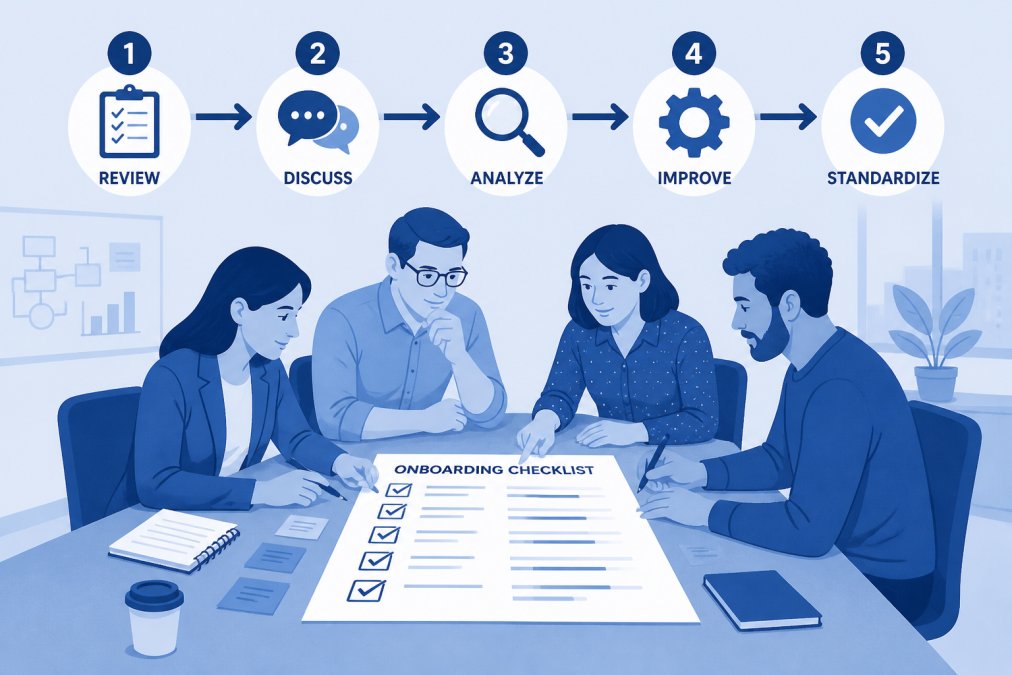
Creating a Client Onboarding Checklist Template
A checklist forces clarity about what needs to happen, who does it, and when.
Your onboarding checklist should cover four phases: before kickoff, during kickoff, after kickoff, and first week.
Before kickoff, confirm you've collected required information, client access, approvals, and resolved dependencies.
During kickoff, cover scope confirmation, authority clarification, decision-making, and alignment on what work can begin immediately.
After kickoff, document what changed and confirm readiness to proceed. Many teams fail here by making decisions without documenting them.
In the first week, specify what work may begin, what is restricted, and what conditions must be met.
A printed sheet or shared document works fine. Every person uses the same checklist, in the same order, every time.
| Phase | Key Activities | Owner | Frequency |
|---|---|---|---|
| Before Kickoff | Collect intake information, verify access, confirm approvals | Account lead | Every engagement |
| During Kickoff | Confirm scope, clarify authority, make decisions, align on work sequence | Project manager + client | Every engagement |
| After Kickoff | Document decisions, confirm readiness, communicate restrictions | Project manager | Every engagement |
| First Week | Monitor dependencies, control work release, resolve startup issues | Delivery lead | Every engagement |
How to Standardize Client Onboarding Across Your Team
Standardization requires a documented process, accountability for following it, and a way to improve it. The real challenge is implementing it when your team is busy delivering work.
Client Start System | Book + Toolkit →
Document your current process, not an idealized one. Observe how onboarding actually happens: where decisions are made, who talks to the client, what information gets lost, what steps are skipped. Many teams fail because they document what should happen, not what actually happens. When the documented process doesn't match reality, the team ignores it.
Identify the critical path: scope confirmation, authority clarification, access provisioning, dependency identification, and readiness confirmation. Strip your process down to these essentials. A process with 5 steps people follow beats one with 15 steps people skip.
Assign ownership for each step to a specific person, not "the team." Without individual ownership, standardization becomes a collective responsibility, which means no one is responsible.
Measure compliance simply: after each engagement, track which steps were completed as documented. After 10-15 engagements, patterns emerge showing which steps are skipped, which cause delays, and which prevent problems.
Most standardization efforts fail because teams measure compliance but don't act on it. If a step is skipped, find out why and redesign it. If a step prevents problems, reinforce it.
Assign someone to own the onboarding process itself, not just executing it, but improving it. This person reviews compliance data quarterly and makes changes. Without this ownership, your process becomes static and standardization decays.
A team needs time to internalize a new standardized process. The process owner should actively reinforce it through reminders, reviews, and feedback. If it's working, it becomes habit.
Pro Tip
Assign a single person to own the onboarding process. Give them authority to enforce it, measure it, and improve it. Without ownership, standardization fails. This person should spend 5-10 hours per month on process management, not delivery work.
Designing a Simple Client Onboarding Process
A simple client onboarding process is documented, repeatable, and focused on what matters for delivery readiness.
Identify the critical path: scope confirmation, authority clarification, access provisioning, dependency identification, and readiness confirmation.
Design your process around these critical activities. If an activity doesn't directly support one, question whether it belongs in onboarding.
Then build in decision gates. Before moving to the next phase, confirm that the previous phase is actually complete. This prevents the common problem of starting work before critical information is resolved.
Finally, design for communication. Your onboarding process should include specific, templated messages to the client at key points. This eliminates confusion about what's been decided and what comes next.
A simple process is often more powerful than a complex one because people actually follow it. When your onboarding workflow is straightforward and focused, your team remembers it. When it's complicated, they find workarounds.
When to Invest in Full-Scale Onboarding Platforms
Full-scale onboarding platforms make sense when you have specific conditions in place. But before you evaluate those conditions, understand the true cost of a platform. Most teams focus on subscription fees and miss the hidden costs that often exceed the software cost itself.
Implementation and setup consume internal time. Someone on your team needs to configure the platform, map your workflow into the system, set up integrations with your existing tools, and test the entire process before going live.
High volume. If you're onboarding 30+ clients per month, automation saves significant time. At that volume, the platform pays for itself through labor savings. Below 30 per month, the time savings are often marginal.
Key Takeaway
The subscription fee is often the smallest part of platform cost. Implementation, training, maintenance, and integration work can add significantly to the total cost. Calculate total cost of ownership before deciding.
Conclusion
The question isn't whether you need a client onboarding platform. The question is whether you need a platform right now, or whether you need a documented, repeatable onboarding workflow first.
Frequently Asked Questions
What is the difference between a workflow problem and a software problem in client onboarding?
A workflow problem exists when your client onboarding process lacks clear steps, ownership, or consistency, regardless of what tools you use. A software problem occurs when your existing tools cannot handle your volume, compliance requirements, or integration needs. Most teams solve workflow problems first through documented procedures and checklists before adding platform complexity. If your onboarding is scattered across email, spreadsheets, and memory, no platform will fix that until the workflow itself is defined.
How can I standardize client onboarding without buying another platform?
Start by documenting your current onboarding steps: agreement translation, intake, gap identification, readiness decision, and kickoff. Create a client onboarding checklist template that your team uses consistently. Assign clear ownership for each stage. Use your existing project-management tool or shared spreadsheet as the system of record. Build repeatable communication templates for client and internal messages. The Client Start System provides a structured methodology and implementation toolkit designed exactly for this, giving you a documented onboarding workflow without requiring new software.
When is it appropriate to invest in full-scale onboarding automation?
Full-scale platforms make sense when you have high client volume, complex compliance or reporting requirements, multiple teams managing onboarding in parallel, or extensive third-party integrations. If you have straightforward intake requirements and manage onboarding with a small team, a simple client onboarding process built on documented workflows typically delivers better results with less overhead. Evaluate whether the platform solves a real operational bottleneck or adds unnecessary layers.
What are the essential components of a repeatable client onboarding system?
A repeatable system includes: a documented client onboarding workflow showing each phase and decision point; a client onboarding checklist template listing required information, approvals, and conditions; clear ownership and authority for each stage; intake templates and communication templates; a readiness decision process; and a method for tracking what changes during kickoff and the first week. These components work together to reduce rework, clarify responsibilities, and protect project momentum from the moment an agreement is signed through the first week of delivery.
Onboarding doesn't have to be chaotic. But adding complexity rarely fixes chaos, it usually amplifies it. Start with a clear, documented workflow. Build consistency. Then, if you need to, layer in the technology. This approach protects you from buying expensive tools you don't need while giving you the foundation to use them effectively if you do.