

Table of Contents
- What an Operational Playbook Is and Why Your Agency Needs One
- Step 1: Audit Your Current Agency Workflows and Identify Gaps
- Step 2: Document Agency SOP Templates and Standard Processes
- Step 3: Build Agency Workflow Examples for Common Deliverables
- Step 4: Standardize Your Client Onboarding Process for Agencies
- Step 5: Implement Agency Workflow Automation to Reduce Manual Work
- Step 6: Drive Adoption and Measure Playbook Performance
- Common Implementation Mistakes to Avoid
- Frequently Asked Questions
Last Updated: October 15, 2026
What an Operational Playbook Is and Why Your Agency Needs One
Operational playbooks for agencies are documented systems that define how your team delivers work, onboards clients, and handles repeatable tasks.
Most agencies struggle with the same problem: client delivery depends on who's doing the work. One team member knows the onboarding sequence. Another remembers which files go where. A third handles scope creep differently than everyone else.
A playbook fixes this. It documents your workflows so any team member can follow the same steps, make consistent decisions, and deliver predictable results. You reduce rework, cut training time, and protect your business when someone leaves.
According to research on business operations and process documentation, companies with documented workflows see measurable improvements in delivery speed and team consistency. The real benefit isn't the document itself.
Workflow Lift provides practical, ready-to-use resources designed to help project professionals and small businesses build clearer, more repeatable operations. The agencies that win aren't the ones with the fanciest software. They're the ones with the clearest processes.

Step 1: Audit Your Current Agency Workflows and Identify Gaps
Start by mapping what you actually do today.
Most agencies skip this step. They jump straight to writing procedures. That's backwards. You need to see your current reality first, gaps and all.
Spend a week documenting your existing workflows:
- How do you currently onboard a new client?
- What happens from project kickoff to delivery?
- Who decides when scope changes?
- How do you track client feedback and revisions?
- What happens when a deadline is at risk?
Write down the actual steps, not the ideal steps. If your onboarding takes three weeks because someone's always waiting for approval, write that down. If you're emailing files back and forth instead of using a system of record, document it.
The goal is to see patterns. You'll notice tasks that happen the same way every time. You'll also spot inconsistencies where different team members do the same work differently.
Pro Tip
Create a simple table with three columns: Task Name, Current Steps, and Gaps. This becomes your audit. You don't need fancy tools yet, a spreadsheet works fine.
Once you've mapped your workflows, identify the biggest pain points. Which tasks create the most rework? Where do clients get confused? What slows down your team most?
These pain points become your priorities. You don't build a playbook for everything at once. You start with the workflows that hurt most.
Step 2: Document Agency SOP Templates and Standard Processes
Now write down how the work should flow.
Standard Operating Procedures are step-by-step instructions for repeatable tasks. They answer the question: "If I'm new to this task, what exactly do I do?"
A solid SOP includes:
- The trigger (what starts the process)
- Each step in order, numbered
- Who owns each step
- Decision points (if X happens, do Y)
- Required inputs and outputs
- Where files live and what they're called
- Escalation rules (when to ask for help)
Start with your highest-impact workflows. For most agencies, that's client onboarding. Document exactly what happens from the moment a client signs a contract to the moment project work begins.

Example structure for a client onboarding SOP:
- Client signs contract → Project Manager receives notification
- PM sends welcome email with project timeline and team introductions
- PM schedules kickoff call within 48 hours
- PM sends pre-kickoff questionnaire to client
- Kickoff call happens → PM documents decisions and next steps
- PM sends kickoff summary email to client and internal team
- Designers receive project brief and begin discovery
- Client receives first deliverable draft by agreed date
Each step should take a sentence or two. If your SOP reads like a novel, it's too detailed. People won't follow it.
Key Takeaway
The best playbooks are short enough to actually use. If your SOP is longer than a page, break it into smaller processes.
Document what happens when things go wrong too. What's your escalation process? Who makes final decisions? How do you handle scope creep?
Step 3: Build Agency Workflow Examples for Common Deliverables
Your playbook needs concrete examples, not just instructions.
Show your team what success looks like. If you deliver client reports, include a sample report. If you run discovery calls, include a sample agenda. If you send project status updates, show the template.
Examples do two things. First, they clarify expectations. Your team sees exactly what "done" means. Second, they save time. Someone can copy your template instead of starting from scratch.
For each major deliverable, create:
- A template or example file
- Notes on what makes it effective
- Common mistakes to avoid
- Where to store the final version
If you use project management software like Asana or Monday.com, these examples live in your system of record. If you use shared folders, store them in a dedicated templates folder.
The key is making examples easy to find. Your team should never spend time hunting for the right template.
Watch Out
Don't create so many templates that your team gets confused about which one to use. Start with the five deliverables you create most often.
Step 4: Standardize Your Client Onboarding Process for Agencies
Client onboarding sets the tone for the entire relationship.
A clear client onboarding process for agencies means every client experiences the same sequence of steps, communications, and expectations. No surprises. No confusion about what happens next.
Your onboarding should cover:
- Initial welcome and team introductions
- Project timeline and key dates
- How the client communicates with your team
- What information you need from them
- First deliverable timeline
- How feedback and revisions work
Most agencies skip the formal handoff. They assume clients know how things work. Clients don't. They're new to your process.
A structured onboarding does three things. It builds confidence (clients feel organized). It reduces questions (you've already explained everything). It protects scope (clients understand what's included and what's not).
Create a written onboarding checklist. Share it with the client during kickoff. Walk through each step so they know what to expect.
Example onboarding checklist:
- Client receives welcome email with team bios
- PM schedules kickoff call
- Client completes discovery questionnaire
- Kickoff call happens, decisions documented
- Client receives project timeline and milestones
- First deliverable assigned to team
- Client receives first draft on agreed date
- Client feedback period opens
When clients know what to expect, they're more likely to provide feedback on time and stay aligned throughout the project.
Step 5: Implement Agency Workflow Automation to Reduce Manual Work
Automation removes the repetitive tasks that slow your team down.
Small Business Workflow Foundation — Book + Toolkit Bundle →
You don't need complicated tools. Start simple. Identify tasks that happen the same way every single time. Those are automation candidates.
Common automation opportunities in agencies:
- Send welcome emails automatically when a contract is signed
- Create project folders automatically with the right structure
- Generate status report templates automatically on Mondays
- Send deadline reminders automatically three days before due dates
- Route client feedback to the right team member automatically
Most project management platforms have automation features built in. You set a trigger (something happens) and an action (something else happens automatically).
Example: When a project moves to "In Review" status, automatically send the client a notification email and create a feedback form.
Automation saves your team hours every week. More importantly, it removes human error. Tasks don't get forgotten. Clients get notified on schedule.
Start with the three tasks that waste the most time. Automate those first. Then move to the next batch.
Pro Tip
Before automating, make sure your process is actually repeatable. If your onboarding changes every time, automation won't help. Get the process right first, then automate it.
Step 6: Drive Adoption and Measure Playbook Performance
A playbook only works if your team actually uses it.
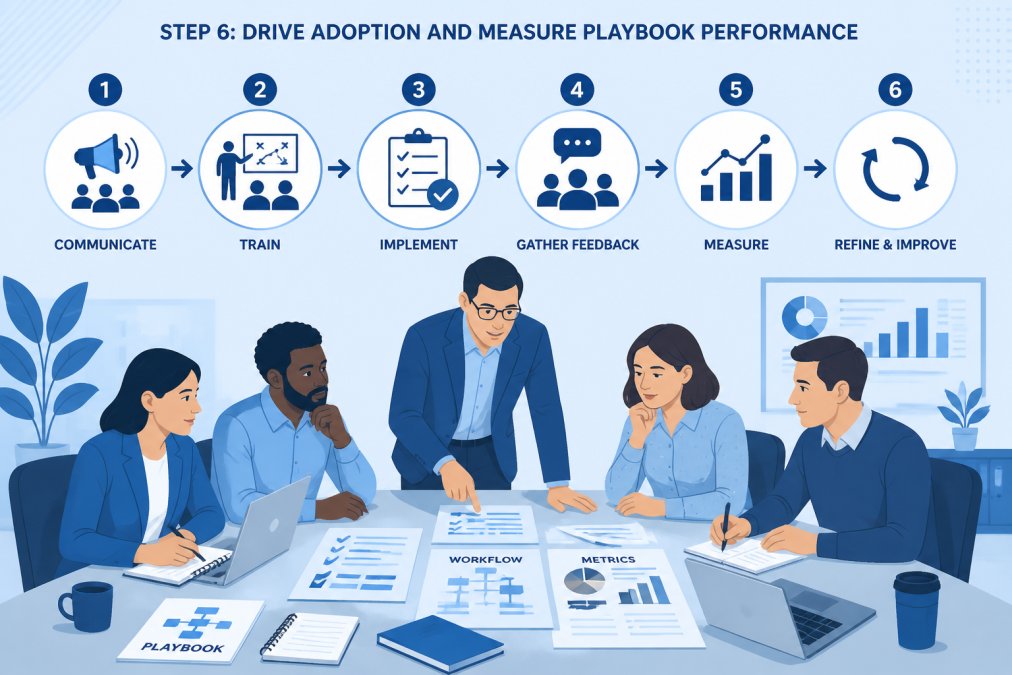
This is where most playbooks fail. You write the procedures, distribute them, and then nothing changes. Your team keeps doing things their own way.
Adoption requires three things: clarity, training, and accountability.
Clarity means your playbook is easy to find and easy to understand. Store everything in one place. Use simple language. Include examples.
Training means your team knows the playbook exists and how to use it. Don't just email it. Walk through it together. Answer questions. Show why it matters.
Accountability means you measure whether people are actually following it. This isn't about punishment. It's about knowing what's working and what needs adjustment.
Create a simple measurement system. Track:
- Are projects following the onboarding checklist? (Yes/No)
- Is scope creep happening less often? (Compare before and after)
- Are clients getting deliverables on time? (Track on-time delivery rate)
- Is rework decreasing? (Compare revision counts)
Measure these metrics monthly. Share the results with your team. Show them that the playbook is actually working.
When your team sees that following the playbook reduces their workload, they'll use it. When they see that scope creep is down and client satisfaction is up, adoption becomes automatic.
Key Takeaway
Playbook adoption takes three to six months. Don't expect immediate change. Build it into your culture gradually.
Common Implementation Mistakes to Avoid
Mistake 1: Making the playbook too detailed.
Your team won't read a 50-page manual. They'll read a five-page guide with examples. Start simple. Add detail only when it's needed.
Mistake 2: Not involving your team in the process.
If you write the playbook alone and hand it down, your team won't own it. Involve them. Ask what's confusing. Let them suggest improvements.
Mistake 3: Setting it and forgetting it.
A playbook isn't finished. It changes as your business changes. Review it quarterly. Update it when you find better ways to do things.
Mistake 4: Automating before standardizing.
Don't automate a broken process. First, get the workflow right. Then automate it. Otherwise you're just automating the mess.
Mistake 5: Ignoring adoption resistance.
Some team members will resist. They've always done it their way. Don't ignore this. Address it directly. Show why the new way works better.
Mistake 6: Not measuring impact.
If you don't measure, you won't know if the playbook is working. Track metrics. Share results. Use data to improve.
Building operational playbooks takes work.
Start with one workflow. Document it. Test it. Refine it. Then move to the next one.
Workflow Lift provides ready-to-use playbooks and templates built from over 15 years of real-world project management and operations experience. The Small Business Workflow Foundation, Book + Toolkit Bundle combines the full 2nd Edition of Small Business Workflow Foundation with practical tools to assess, design, control, and improve workflows. The Client Delivery System, Book + Toolkit Bundle focuses specifically on standardizing client onboarding and project delivery for agencies.
Frequently Asked Questions
What is the difference between an operational playbook and an SOP?
An SOP (standard operating procedure) documents a single task or process step-by-step. An operational playbook is broader, it connects multiple SOPs into a complete workflow system that shows ownership, decision points, handoffs, and how processes interact. A playbook gives your agency the full operating system; SOPs are the building blocks within it. Implementing operational playbooks for agencies means treating the entire delivery cycle as an interconnected system rather than isolated checklists.
How long does it actually take to implement an operational playbook in an agency?
Most agencies see initial adoption in 4 to 8 weeks, depending on size and complexity. Auditing workflows takes 1-2 weeks. Documenting processes and building templates takes 2-4 weeks. Rolling out to the team and refining based on feedback takes another 2-4 weeks. Smaller teams (under 10 people) move faster; larger teams need more coordination. The Small Business Workflow Foundation Toolkit ($11.99) provides ready-made design tools that compress the documentation phase significantly.
What happens if our team doesn't actually use the playbook after we implement it?
Non-adoption is the most common implementation failure. To prevent it: assign a process owner for each workflow, make adoption a performance expectation, start with the highest-pain processes first (not everything at once), train the team in small sessions, and measure early wins visibly. Show the team how the playbook reduced rework or missed deadlines, this builds buy-in. Playbooks that sit unused are usually too complex, launched too fast, or lack visible ownership. Start simple, prove value, then expand.
Can a solo consultant or small freelancer benefit from an operational playbook?
Yes. Even solo consultants benefit from documenting client onboarding, delivery phases, and closeout steps. A playbook clarifies your own process, makes you faster at repeating work, and creates a foundation if you ever hire help. It also reduces the mental load of remembering what to do next. Solo consultants often waste time reconstructing the same process for each client. A simple playbook eliminates that rework. As you grow, the playbook becomes the training manual for your first hire.