
One of the most common phrases in project management is:
“We need to get the stakeholders aligned.”
That usually sounds like a call for agreement.
Get everyone in a room. Talk through the options. Find common ground. Leave with everyone supporting the same direction.
It sounds reasonable.
It is also not how many complex projects actually work.
Stakeholders rarely enter a project with identical priorities, constraints, incentives, risks, or definitions of success. A finance leader may care most about cost certainty. Operations may prioritize continuity. Technology may care about architecture and maintainability. Sales may be protecting commitments already made to the customer.
Those perspectives can all be legitimate.
Trying to eliminate every disagreement before moving forward can create a different kind of project risk: decision paralysis.
The more useful question is not:
“Does everyone agree?”
It is:
“Are we aligned enough to make a clear decision and move forward?”
Alignment and Agreement Are Different
A recent ProjectManagement.com discussion challenged the idea that stakeholder alignment means everyone must agree. The argument was straightforward: real alignment is better defined by clarity around decisions, trade-offs, disagreements, ownership, and commitment to move forward.
That distinction matters.
A project can have disagreement and still be aligned.
For example:
-
One stakeholder may prefer Option A.
-
Another may strongly prefer Option B.
-
Both understand the business objective.
-
Both understand the trade-offs.
-
Decision authority is clear.
-
A decision is made.
-
Both understand what happens next.
-
Both support execution even though one did not get their preferred outcome.
That is alignment.
It is not consensus.
And for many projects, it is much more realistic.
Why Chasing Consensus Can Hurt a Project
Consensus can be valuable when the decision genuinely requires broad ownership.
But making unanimous agreement the default standard can introduce several problems.
Decisions slow down
Every additional stakeholder effectively gains an informal veto.
Instead of deciding, the project team keeps scheduling another meeting, collecting more feedback, and adjusting the proposal in hopes that everyone will eventually become comfortable.
Sometimes the result is better.
Sometimes the project simply loses momentum.
Solutions become diluted
When every objection has to be eliminated, teams can end up designing around the least controversial option rather than the strongest one.
The project technically reaches agreement, but the decision becomes a compromise that nobody particularly believes in.
Disagreement goes underground
There is another danger.
People often recognize when the organization expects them to “align.”
So they stop openly disagreeing.
The meeting ends with apparent consensus, but the underlying objections remain.
Those objections then reappear later through:
-
delayed approvals,
-
passive resistance,
-
competing priorities,
-
escalations,
-
resource conflicts,
-
or last-minute attempts to revisit decisions.
Visible disagreement is manageable.
Hidden disagreement is much harder.
Start With the Definition of Success
Stakeholders often appear to disagree about solutions when they actually disagree about something more fundamental.
They may define success differently.
One recent ProjectManagement.com discussion made this point well: stakeholder alignment often improves when teams first align around the problem, value to be created, measures of success, and decision criteria—rather than immediately debating preferred solutions.
Before discussing what the project should do, ask:
-
What problem are we solving?
-
What outcome matters most?
-
How will we know the project succeeded?
-
What constraints are non-negotiable?
-
What trade-offs are acceptable?
-
What risks are we willing to take?
-
Which decision criteria should win when priorities conflict?
That conversation often reveals why stakeholders appear misaligned.
They may not be arguing about the same question at all.
Clarify Decision Authority
One of the fastest ways to create stakeholder friction is to leave decision rights ambiguous.
Several people believe they are responsible.
Or nobody believes they are.
Or everyone assumes the executive sponsor will eventually make the call.
Before major decisions arise, clarify:
Who recommends?
Who provides input?
Who makes the decision?
Who owns execution after the decision?
Who must simply be informed?
This does not mean stakeholder input becomes unimportant.
It means the project understands how input turns into a decision.
Without that clarity, stakeholder alignment discussions can become endless because no one knows when the discussion is actually finished.
Make Trade-Offs Visible
Most meaningful project decisions involve trade-offs.
Faster delivery may increase risk.
Lower cost may reduce scope.
More customization may increase complexity.
Stronger controls may reduce flexibility.
One stakeholder may value speed more than certainty. Another may value certainty more than speed.
Alignment improves when those trade-offs are stated explicitly.
Instead of:
“Which option do you support?”
ask:
“Which trade-off are we willing to accept?”
That changes the quality of the conversation.
Stakeholders are no longer simply defending preferences. They are evaluating consequences.
Treat Disagreement as Information
Project managers are often trained to resolve conflict.
That is useful.
But disagreement should not automatically be treated as a problem to eliminate.
Sometimes disagreement is telling you something important.
A stakeholder may see an operational dependency the project team missed.
Another may understand customer expectations better than the delivery team.
A technical leader may recognize long-term consequences that are invisible in the immediate business case.
A recent 2026 study of a complex European infrastructure project described stakeholder misalignment as involving misunderstandings, conflicting priorities, and collaboration breakdowns that can materially hinder progress. The researchers found value in structured, participatory approaches that helped stakeholders surface and work through those misalignments.
The goal, then, is not to suppress disagreement.
It is to surface it early enough to use it.
Watch for Informal Stakeholders
Formal stakeholder maps are useful.
They are also incomplete.
Every organization has people who influence decisions without appearing prominently on the project chart.
They may be:
-
a trusted advisor to an executive,
-
a senior operational leader,
-
a technical expert,
-
a long-tenured employee,
-
or simply the person others quietly consult before committing.
A recent ProjectManagement.com article described this as the difference between the organization's official map and its real network of trust and informal authority.
That matters during project startup.
A stakeholder who is technically outside the formal approval chain can still undermine a decision if their influence was ignored.
Good stakeholder alignment therefore requires more than identifying names and titles.
It requires understanding how decisions actually move through the organization.
What Should Be Aligned Before Kickoff?
Before kickoff, I would want clear answers to at least these questions:
1. What does success mean?
Not just the project objective.
What does success look like from the perspective of the major stakeholders?
2. Who has decision authority?
When priorities conflict, who makes the call?
3. What does each stakeholder own?
Ambiguous ownership is one of the fastest paths to later conflict.
4. What are the major trade-offs?
What are we willing to give up in exchange for speed, cost, quality, scope, or risk reduction?
5. Where do stakeholders currently disagree?
Do not hide this.
Write it down.
6. How will unresolved disagreements be escalated?
Projects need a decision path before they need it.
7. Can everyone support execution after a decision?
This may be the most important question.
A stakeholder does not need to love the decision.
But the project does need to know whether they will support moving forward.
The PM's Job Is Not to Manufacture Harmony
Project leadership sometimes gets confused with keeping everyone happy.
That is not the job.
The project manager's responsibility is to create enough structure and transparency that the organization can make good decisions and execute them.
Sometimes that produces agreement.
Sometimes it produces a clear decision despite disagreement.
Both can represent successful stakeholder alignment.
The unhealthy state is not disagreement.
It is ambiguity.
Ambiguity about what was decided.
Ambiguity about who owns it.
Ambiguity about why the decision was made.
Ambiguity about whether stakeholders are actually committed.
A Better Definition of Stakeholder Alignment
For practical project delivery, I would define stakeholder alignment this way:
Stakeholders understand the objective, decision, trade-offs, responsibilities, and next steps—and are prepared to support execution even when they do not all share the same preference.
That definition leaves room for healthy disagreement.
It also creates accountability.
You can disagree and still commit.
You can challenge a decision and still understand who has authority to make it.
You can have competing priorities while still maintaining a coherent project direction.
That is far more useful than forcing artificial consensus.
Alignment Starts Before the Project Does
This is one more reason strong project management begins before kickoff.
Stakeholder identification alone is not enough.
You need to understand:
-
who matters,
-
what success means to them,
-
what they control,
-
where their priorities conflict,
-
how decisions will be made,
-
and what commitment looks like after the decision.
A stakeholder register tells you who is involved.
Stakeholder alignment tells you whether those people can actually move the project forward together.
Those are very different things.
Identify stakeholders. Then align them.
Build Stronger Project Starts
Workflow Lift focuses on practical ways to create clearer project starts, stronger ownership, and more repeatable delivery.
Explore Workflow Lift → https://workflowlift.com
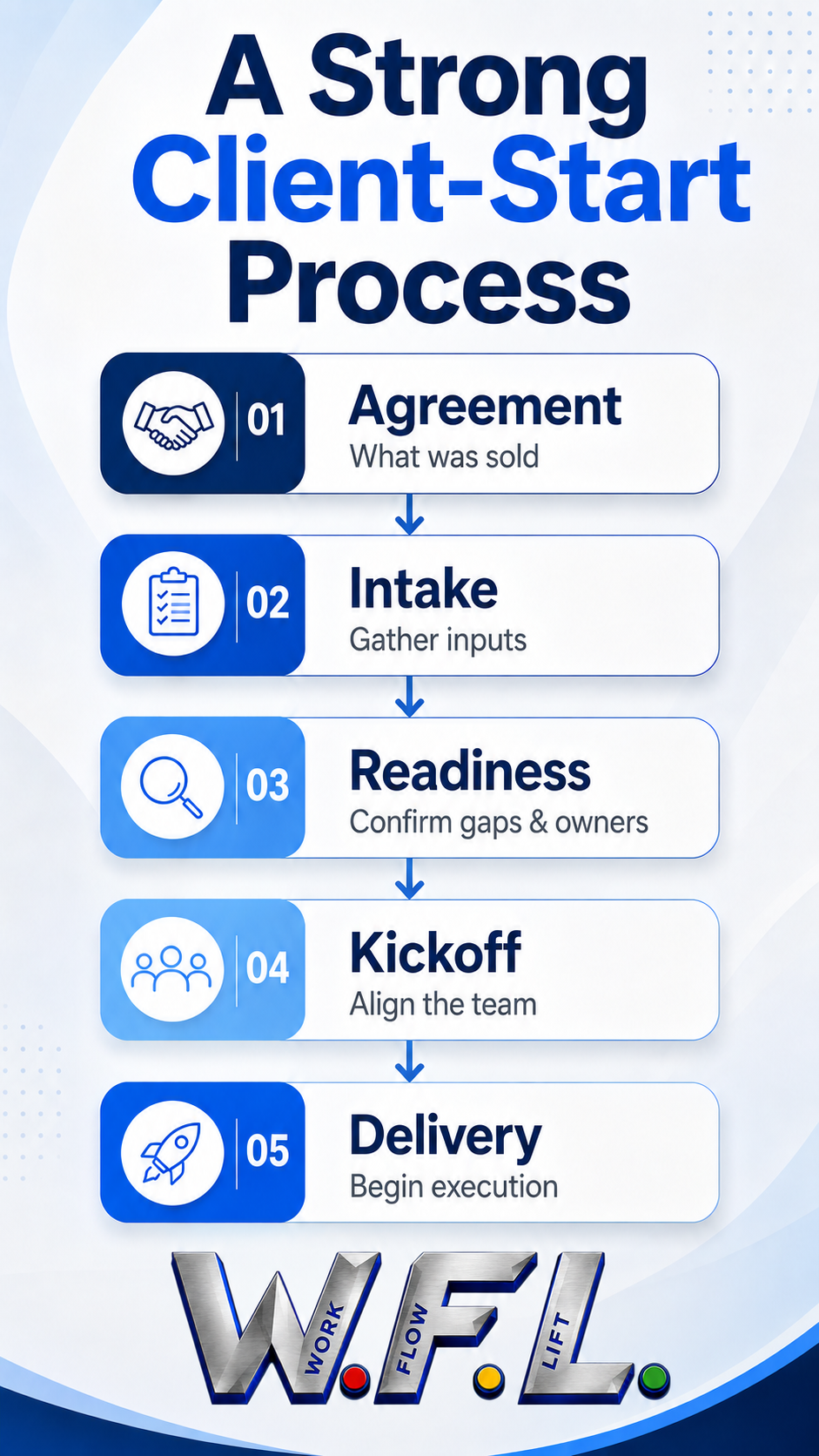
For a structured approach to moving client work from agreement through intake, readiness, kickoff, and delivery:
Explore The Client Start System → https://workflowlift.com/products/the-client-start-system-complete-book-implementation-bundle