
A surprising amount of business work still runs on memory.
Someone remembers which email needs to go out. Someone knows which spreadsheet contains the latest information. A project manager remembers what happened the last time a similar project went wrong. A business owner keeps a mental list of the things that need to happen before a client can move forward.
That can work for a while.
But as the number of customers, projects, employees, vendors, and responsibilities increases, memory becomes a poor operating system.
The problem usually is not that people are unwilling to work hard. The problem is that important work has never been turned into a reliable process.
When the process lives in someone's head
You can often recognize this problem by the symptoms.
Important steps are completed differently depending on who performs them. Client onboarding changes from one customer to the next. Project status becomes difficult to explain without checking several systems. Handoffs depend on conversations rather than defined requirements. Problems are discovered late because nobody established when they should become visible.
And when the person who normally handles the work is unavailable, progress slows down.
Those are not simply productivity problems.
They are system-design problems.
A repeatable business needs a repeatable way to perform the work.
Start with the workflows that repeat
You do not need to document every task your business performs.
Start with the work that happens repeatedly and matters to the outcome.
That might include:
- qualifying a new opportunity
- preparing for a client kickoff
- defining project scope
- assigning ownership
- approving changes
- communicating project status
- escalating risks
- completing quality checks
- closing a project
- transferring work into ongoing operations
The objective is not bureaucracy.
The objective is to make the important parts of the business visible, repeatable, and controllable.
When a workflow is clear, people spend less time figuring out what should happen next and more time actually doing the work.
Build. Align. Control.
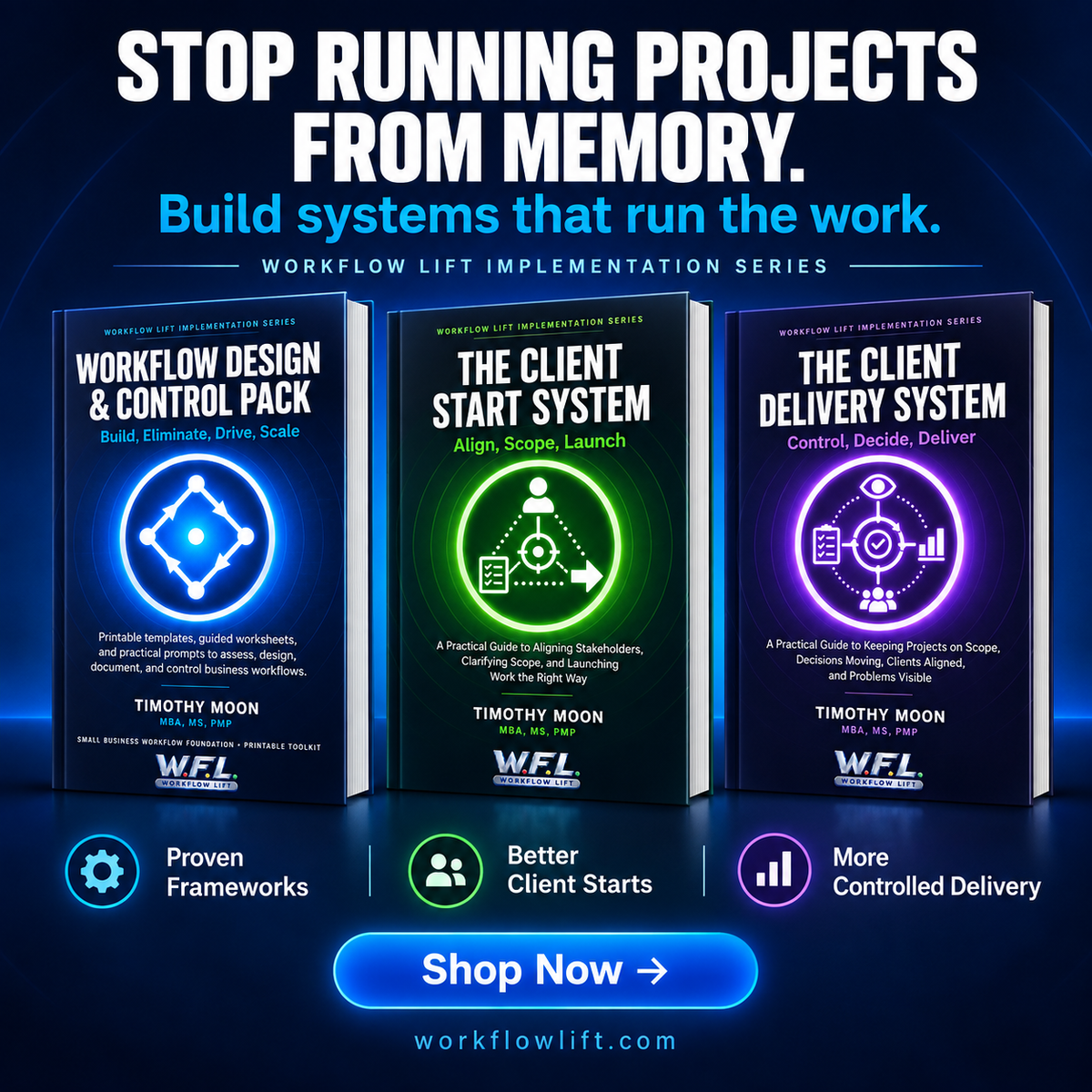
That principle is behind the Workflow Lift Implementation Series.
The series is designed as a set of practical operating resources rather than theory-only business books.
Workflow Design & Control Pack
The Workflow Design & Control Pack helps you examine an existing workflow, determine what belongs in it, remove unnecessary activity, clarify ownership, and establish controls that make the process easier to manage.
The goal is straightforward:
Build. Eliminate. Drive. Scale.
Instead of starting with software, the process starts with the work itself.
What should happen?
Who should own it?
What information is required?
Where can the process fail?
What should be measured or controlled?
Once those questions are answered, automation and technology become much easier to apply intelligently.
The Client Start System
A project can begin badly long before anyone recognizes that there is a problem.
Unclear expectations, weak scope definition, missing information, uncertain ownership, and poorly structured kickoff meetings frequently create problems that appear later during delivery.
The Client Start System focuses on the transition from opportunity to active work.
Its operating idea is:
Align. Scope. Launch.
The objective is to establish enough clarity at the beginning that the delivery team is not forced to reconstruct the agreement while the project is already underway.
That means better stakeholder alignment, clearer scope, stronger readiness, and a more controlled project launch.
The Client Delivery System
Once work begins, the management problem changes.
Now the team must maintain visibility.
Scope needs to remain controlled. Decisions need owners. Issues need to surface early. Clients need meaningful information. Changes need to be evaluated rather than casually absorbed into the project.
The Client Delivery System focuses on that operating environment.
Its framework is:
Control. Decide. Deliver.
The purpose is not to eliminate uncertainty. Projects will always contain uncertainty.
The purpose is to create a system capable of dealing with uncertainty without allowing every new problem to become chaos.
Systems reduce dependence on heroics
Good businesses often survive because capable people repeatedly step in and save difficult situations.
That can look like high performance.
Sometimes it is.
But if the same types of problems require repeated heroic intervention, the organization may actually be compensating for a weak system.
A stronger operating model captures what those experienced people know and turns as much of it as possible into a repeatable process.
That does not remove human judgment.
It makes human judgment more valuable because people are no longer spending as much time solving preventable problems.
The goal is not more process
There is an important distinction here.
More process is not automatically better.
A badly designed process can create just as many problems as having no process at all.
The goal is the minimum structure necessary to produce a reliable outcome.
That may mean a checklist.
It may mean a workflow.
It may mean a decision log, readiness review, status dashboard, approval point, risk trigger, or defined handoff.
The correct tool depends on the work.
But the principle remains the same:
Important work should not depend entirely on someone remembering what to do next.
Build the system once. Improve it continuously.
A workflow should not become permanent simply because it has been documented.
Use it.
Observe it.
Find the friction.
Remove unnecessary steps.
Strengthen weak handoffs.
Clarify confusing decisions.
Automate repetitive work when automation genuinely improves the process.
Then run it again.
That is how a business gradually moves away from improvisation and toward an operating system that can support growth.
Start building better workflows
If your business or projects depend too heavily on memory, scattered notes, inconsistent handoffs, or individual heroics, start by examining one recurring workflow.
Map what happens today.
Identify where it breaks.
Clarify what should happen instead.
Then build the structure that makes the better process repeatable.
The Workflow Lift Implementation Series was created to help you do exactly that.
Build better systems. Start clients more effectively. Deliver projects with greater control.