

Table of Contents
- Why HR Consistency Matters: Risk, Compliance, and Culture
- Standard Operating Procedures for HR Consultants
- Building Documentation Standards That Protect Decisions
- Reducing Scope Creep in HR Consulting
- HR Consulting Project Management Templates
- Client Onboarding Checklists for HR Consultants
- Training Managers and Teams for Consistent Execution
- Implementing Decision-Making Audit Frameworks
- Frequently Asked Questions
Last Updated: September 20, 2026
Why HR Consistency Matters: Risk, Compliance, and Culture
HR consistency separates businesses operating on memory from those running on repeatable systems. Inconsistent HR decisions expose the business to legal risk, erode employee trust, and create costly mistakes.
Unstandardized hiring creates salary inequities and discrimination exposure. One manager hires for cultural fit, another for technical skills, a third on gut instinct. Performance management suffers similarly: some managers document everything, others nothing.
Employment law requires fair treatment, documented decision-making, and defensible reasoning. Without an audit trail proving consistent, legitimate decisions, you're vulnerable to legal challenge. Unstructured salary reviews make it impossible to prove pay equity.
HR consistency shapes culture. Employees notice when policies apply differently by manager, when flexibility varies by team, or when accountability standards shift. This inconsistency breeds resentment and drives retention problems.
HR consistency improves operational efficiency: faster onboarding, predictable conflict resolution, and knowledge retention. The business runs on documented procedures, not on who remembers how things work.
Standard Operating Procedures for HR Consultants
Standard operating procedures form the backbone of HR consistency, transforming ad hoc judgments into repeatable processes with clear authority, criteria, and documentation.
An effective HR SOP defines the trigger, decision criteria, decision-maker, evidence requirements, and next steps. For hiring: document job requirements, define evaluation criteria upfront, use structured interviews with identical questions, and record the selection rationale.
For performance management, an SOP specifies review timing, measurement criteria, documentation, and performance consequences. It doesn't eliminate judgment but ensures it's applied consistently and defensibly.
For compensation, an SOP establishes salary bands by role, review timing, justification factors, and decision documentation. This creates pay equity by design.
Business owners often resist documentation, fearing bureaucracy. Clear SOPs actually reduce burden by eliminating process reinvention and clarification cycles.
Building SOPs requires understanding the client's actual process: interview staff, observe decisions, document friction points, then standardize what works while fixing what doesn't.
Building Documentation Standards That Protect Decisions
Documentation transforms a decision from opinion into defensible choice. Without it, you cannot prove decisions were fair, legitimate, or consistent.
Effective HR documentation captures what decision was made, when, who made it, and why. The "why" is critical: the difference between "we hired Jane" and "we hired Jane because she scored highest on our structured interview rubric measuring technical skills, communication, and problem-solving."
Documentation standards specify what gets documented, by whom, where, and retention periods. Hiring decisions need interview notes and scoring rubrics. Performance conversations need date, topics, and next steps. Terminations need documented performance issues, prior warnings, and business reason.
Documentation is often scattered across email, spreadsheets, and notebooks. Establish a system of record, a single place for decisions and evidence. The tool matters less than consistency.
Documentation standards must address what NOT to document: personal opinions, assumptions about protected characteristics, and emotional reactions. These create legal liability. Train managers on legitimate business reasons versus personal judgment.
Specify access rules: compensation visible only to manager and HR, performance records accessible to employees, investigations restricted. Clear access rules protect privacy and build trust.
Reducing Scope Creep in HR Consulting
Scope creep happens through unclear boundaries, changing expectations, and the consultant's desire to be helpful.
An engagement starts with defined scope: "We're implementing a new performance management system." Then requests accumulate: "Look at compensation?" "Update the handbook?" "Train managers?" Each seems reasonable; together they expand beyond plan and budget.
Start with a written scope statement specifying what's included and what's not, with deliverables, timeline, client responsibilities, and a change control process for new requests.
Small Business Workflow Foundation →
When clients ask for additions, the consultant's job is to acknowledge the request, explain how it affects the original timeline and budget, and let the client decide. Some requests get added to a future phase. Others get deferred. Some get declined. The key is making the trade-off visible.
Many consultants struggle with this because they worry about losing the client. The reality is that scope creep costs more relationships than boundary-setting does. When a project expands beyond what's manageable, quality suffers, deadlines slip, and the client becomes frustrated. A clear scope, enforced respectfully, actually strengthens the relationship.
Documentation tools like project checklists and change logs make scope management visible. When a client requests something new, you log it, explain the impact, and get agreement on how to handle it. This creates a paper trail and prevents the "I thought that was included" conversations that damage trust.
HR Consulting Project Management Templates
Templates accelerate project delivery and reduce the rework that comes from reinventing processes each time. Effective HR consulting templates address the phases of a typical engagement: discovery, design, implementation, and closeout.
Discovery templates capture the current state. What HR processes exist? What's working? What's creating friction? A discovery template might include interview guides, assessment worksheets, and a summary document that synthesizes findings into key themes and recommendations.
Design templates help structure the solution. If you're designing a new performance management system, a template might outline the rating scale, the review timeline, the feedback structure, and the documentation requirements. It gives the client something concrete to react to rather than starting from a blank page.
Implementation templates break the work into tasks. A template might list the steps for rolling out a new policy: draft the policy, get leadership approval, communicate to employees, train managers, pilot with one department, refine based on feedback, and full rollout. Each step has a task owner, a deadline, and success criteria.
Closeout templates ensure nothing falls through the cracks. They specify what documentation needs to be handed over, what training needs to happen, what systems need to be set up, and what ongoing support is planned. They also define what success looks like so there's no ambiguity about whether the project actually worked.
Templates save time because you're not starting from zero each time.
Client Onboarding Checklists for HR Consultants
Client onboarding sets the tone for the entire engagement. A structured onboarding checklist ensures you gather the information you need, establish clear expectations, and start building the relationship on solid ground.
| Onboarding Phase | Key Activities | Owner | Timeline |
|---|---|---|---|
| Logistics | Gather contact info, set communication cadence, establish access | Consultant | Day 1-2 |
| Discovery | Interview stakeholders, request documents, assess current state | Consultant + Client | Week 1-2 |
| Alignment | Confirm goals, timeline, budget, success criteria | Consultant + Leadership | Week 2 |
| Planning | Develop project plan, define deliverables, schedule kickoff | Consultant | Week 3 |
Training Managers and Teams for Consistent Execution
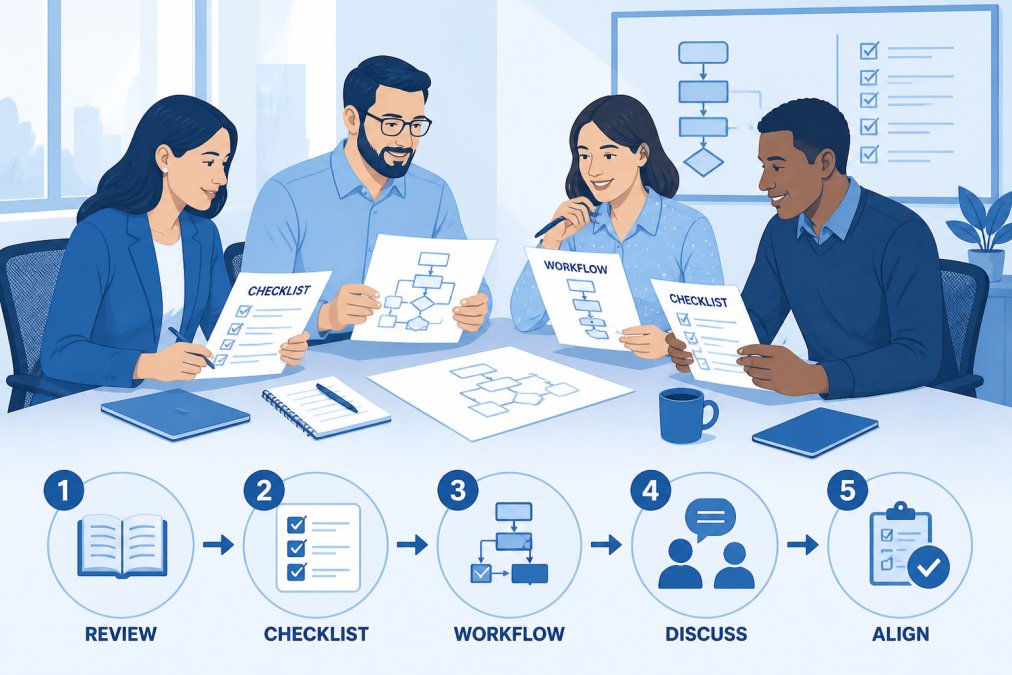
Policies and procedures only work if people follow them. Training managers and teams ensures that HR consistency becomes embedded in how the business operates.
Implementing Decision-Making Audit Frameworks
A decision-making audit framework lets you verify that HR processes are actually being followed and producing consistent results. It's the accountability mechanism that keeps the system honest.
Frequently Asked Questions
How can HR consultants ensure consistency across different client projects?
Use standardized client onboarding checklists, documented decision criteria, and repeatable workflows. Build audit trails that show which decisions were made, by whom, and why. Create role-based authority maps so every team member knows their decision boundaries. Document your standard operating procedures once, then customize them for each client's specific context rather than reinventing from scratch. This approach reduces errors and ensures fair treatment across all engagements.
What systems protect HR consulting firms from scope creep?
Establish written scope agreements that define what is included and excluded before work begins. Use change-request forms to track any additions or modifications. Build project management templates that separate billable work from scope creep early. Set up regular scope reviews at defined project gates. Document decision authority so consultants know when to escalate scope changes to management. Clear boundaries and documented change processes prevent scope from expanding without acknowledgment or adjustment.
Why is standardized documentation critical for HR consulting compliance?
Documentation creates audit trails that prove fair treatment, consistent application of policies, and compliance with employment law. If an employment dispute arises, your records show the decisions you made, the criteria you used, and the evidence supporting those decisions. Standardized templates ensure nothing is missed. They also reduce legal exposure by demonstrating that your firm followed its own documented procedures consistently across clients. Documentation is your defense against claims of bias or negligence.
What are the best practices for documenting HR decision-making processes?
Record the decision, the date it was made, who made it, what criteria were used, and what evidence supported it. Separate decisions from recommendations. Create decision logs that track approvals and sign-offs. Use consistent language and formatting so decisions are easy to audit later. Store documentation in a system of record where access is controlled and changes are tracked. Include escalation paths so complex decisions move to the right authority level. This structure protects both the consultant and the client by creating a clear, defensible record.
How do you build a repeatable HR consulting framework?
Start by mapping your current process for a typical engagement from discovery through delivery. Identify the key decisions, handoffs, and control points. Document each step, the inputs required, the person responsible, and the expected output. Create templates for common deliverables like policy audits, compensation reviews, or compliance assessments. Test the framework on a real project and refine it based on what actually happened versus what you planned. Build in checkpoints to catch deviations early. A repeatable framework reduces rework and improves delivery predictability.
What one thing would improve how HR consultants deliver consistency to clients?
Establish a single system of record for each client engagement that captures decisions, approvals, and evidence in one place. Too many consultants rely on email, scattered documents, or individual memory. A centralized record, whether a shared spreadsheet, project management tool, or dedicated workbook, ensures everyone sees the same truth. It prevents conflicting decisions, reduces rework from miscommunication, and creates the audit trail needed for compliance. This single change eliminates most consistency problems.
How much time does it take to implement HR consistency systems?
Initial setup typically takes 4-8 weeks depending on firm size and complexity. Start by documenting your current process without changing anything, then identify the highest-risk decisions and workflows. Build templates and checklists for those areas first. Roll out to one client project as a pilot before firm-wide adoption. Most teams see measurable improvements within 90 days of consistent use. The investment pays back quickly through reduced rework, fewer compliance issues, and faster delivery cycles.